Wednesday, September 16, 2020

The Saloon

On my recent tour through western and northern Minnesota, I had a lot of "handlebar" time to think about things, most especially, COVID.

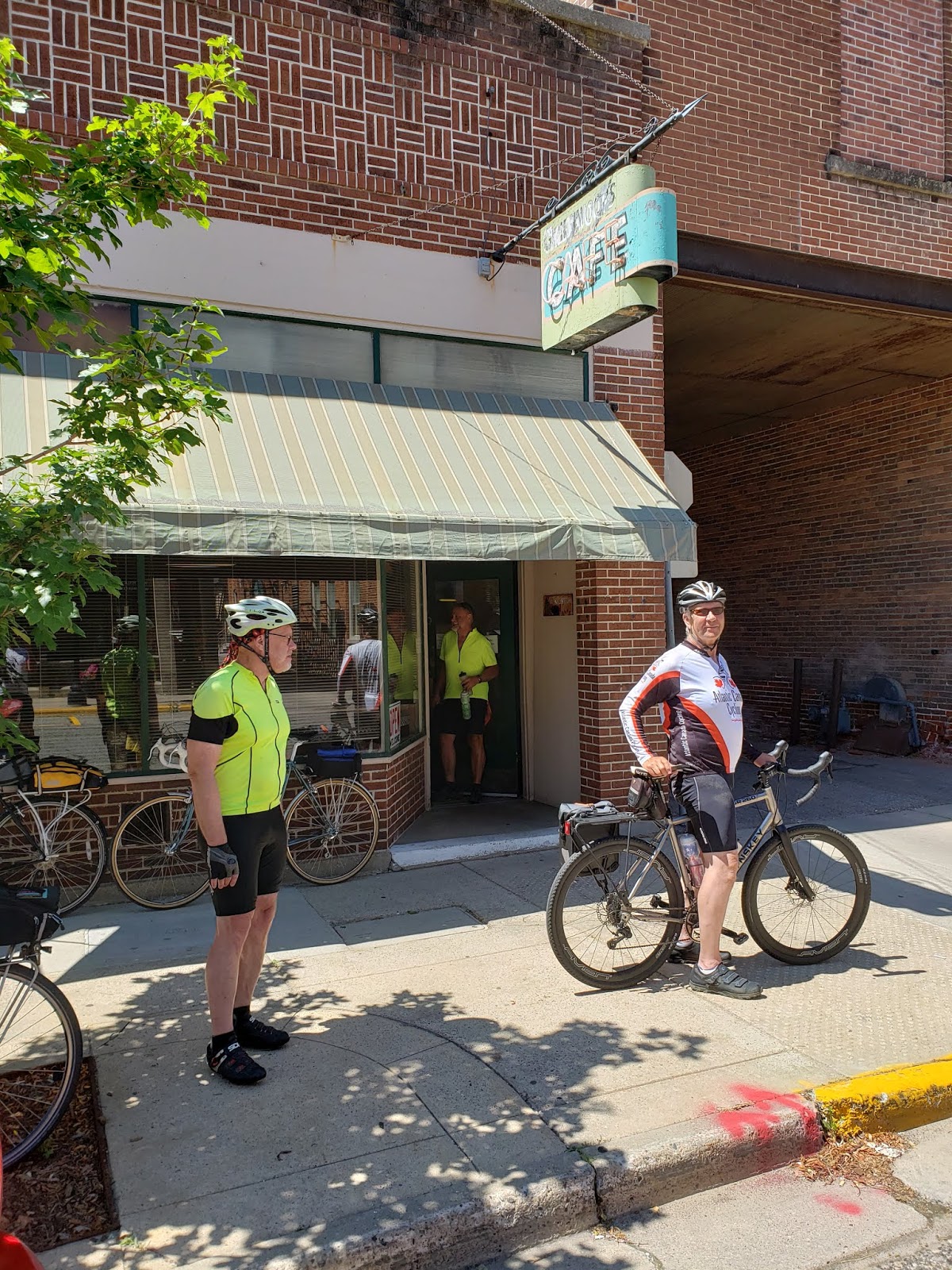
Much of outstate Minnesota is a frontier, where the old revolutionary concept of "don't tread on me" seems apparent.  And I kind of get it.  Jobs are challenging and hard here - logging, mining, farming - with many proud communities that appear to be just getting by, on their own, away from the loud melee that is the government mandates. For the most part, businesses in this area were doing their part to comply with the Governor's mask orders.  Indeed, the Hungry Duck Cafe, where the ham dinner ordered to go was exemplary after a long ride day as they were closing, even took our contact information down for their social tracing when we returned for breakfast in the morning.

But there were exceptions.  In one small frontier town, I went to the only local establishment - a tavern - to order a pizza for dinner, upon the recommendation of the unmasked convenience store clerk I visited upon arrival in town, asking directions to our motel.  I approached the entrance to the tavern, read the government mandated "masks required," slipped on my mask, and walked in.  

Now, imagine an old western film for a moment, where the "outlaw" wanders down an empty street, tumbleweeds tumbling, dust blowing.  Alone on this street, sensing eyes upon him peering from windows, he approaches the tavern.  Pausing, he holsters his mask around his  ears, and pushes the saloon doors open, all eyes of the patrons turned upon him as he gathers the sense of the place.

The patrons were all maskless, likely known to each other, and certainly took note of him (probably profiling him immediately, thinking "not from around here, are ya?").  He started to approach to order, when a woman dashed around the horseshoe shaped bar, and as she approached his vicinity, lifted her pullover to cover her mouth as she trotted past to her seat among friends in the opposite corner, all the while talking loudly to the other patrons.  The conversation around this small bar was why she was covering up, and she said she was a teacher and she had to do it in school.  

Hmmm, this outlaw thinks: "not here too?  Bringing it back to the kiddies, are we, who bring it back to . . .?"

Fully self-conscious, this outlaw defiantly kept his mask on, approached the humorless, unmasked bartender leaning close in to hear, ordered the pizzas, and mentioned he would wait outside.   Payment tendered, the cowboy turns and exits the scene, discomforted, but capturing in this exchange the essence of this frontier.  

Oh, the pizza was very good, distanced, in our small motel room.


Friday, September 11, 2020

Leaving to Go Home - MnLOOP COVID Tour

In a way, as soon as you leave, you're heading home.  On a bicycle, that is.

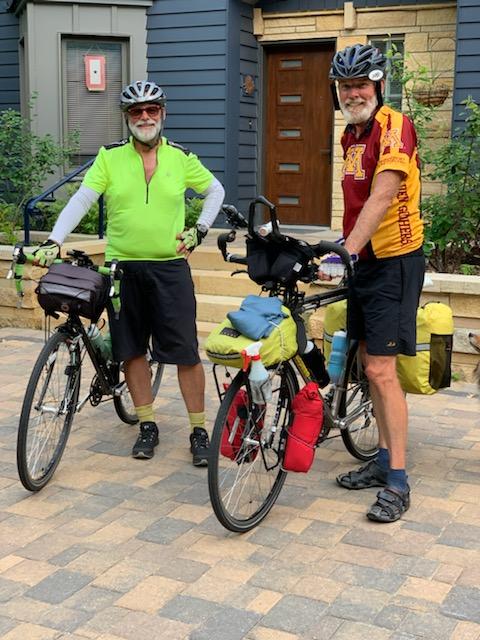
COVID-19 limited our options in 2020.  Rich Freyholtz, my long time touring partner, and I decided we needed to stay close to home to satsify our itch for an annual bicycle tour.  Since we were Driftless last year (Wisconsin/Minnesota driftless region), we decided a trip to "find northern Minnesota" was in order.  Having lived in this State since 1980, there is still much that I have not seen of the State - most of it actually.  Rather than provide a detailed day-by-day journal, I offer the highlights.

As we were coasting toward home on our 15th and final day, Rich asked what geometric shape would our route have taken?  Since we returned, I have studied the map - again - and determined it is a rectangle, slightly rotated, with the twin cities in the bottom corner, Detroit Lakes as the westernmost terminus going northwest up the short side, International Falls at the end of a long side as the northernmost terminus, Beaver Bay on Lake Superior down the next side and the eastern terminus, and back home on a long side.

Geometry is useful after all!

972 miles, give or take, the perimeter of our rectangle.  Crossed continental divides separating all three watersheds - Mississippi, Lake Superior, and Hudson Bay.  Camped some.  Motel-ed some. Sometimes ate well, (especially "catered" food brought by friends for a rest day in Lake Itasca), sometimes not so well.  Generally fine weather - some hot, some quite cool days.  Fierce headwinds and luxuriant tailwinds - both when least expected. Saw a coyote and a bear, but they did not await their photo portrait.  Had long, straight and flat rails to trails, and roller coaster hills to tax the mind and legs, with some gravel roads to test our mettle.  Unplanned detours for road construction that stretched our mileage. Surrendered pints blood to countless mosquitoes in Lake Itasca - as bad as I had ever experienced.  Yet we wore everything we had to stay warm in an unexpected cool snap.  One flat tire (Rich) and one worn out tire (Peter) - but solid bikes that held their own with gear that always seemed to weigh too much.

In other words, a good ride!  The highlights:

Glendalough State Park

Located southeast of Detroit Lakes, north of the resort town of Battle Lake, this is a newer State Park, deeded to the State in 1992 by the Cowles Family, owners of the Start Tribune newspaper.  The property was assembled by F. E. Murphy in 1928 and served as a corporate retreat that over its history brought two presidential candidates (Eisenhower and Nixon) to the site, no doubt for fishing and the "get to know the candidate" interview.  To the west starts the rolling prairie landscape, to the north and east the mixed hardwood forest. With walk-in tent sites only, multiple lakes, and a paved path around Annie Battle Lake, this proved a peaceful respite the morning and night.


Phelps Mill

Otter Tail county is really the edge of the glaciated region, with the Otter Tail river flowing somewhat lazily past the Phelps Mill.  I was not expecting such a place on this journey, but signs indicated the direction to the mill enticed us to veer from the planned path, revealing a lone remnant of a flour mill, one of over a thousand that used to dot Minnesota.  Constructed in 1888-89 by a builder that also constructed a low-rise dam to power the mill, it was quite productive in the region until electricity and the railroads made milling on such a small scale less affordable.  The mill closed in 1939, but was fortunately restored and turned over to the county in 1965.  The Phelps Mill District is really just a few buildings - the mill, the miller residence that itself is quite attractive, and a general store that still is in operation (but not open during our visit).  This was a surprise stop for me as a lover of history.


Tamarac National Wildlife Refuge

This also was a surprise.  We expected to merely pass through these roads, not fully realizing that they traversed a national Wildlife Refuge.  A nice paved road abruptly ended in gravel, much  to our disdain, but in generally good riding condition. The road wound through wetlands, lakes, and over small eskers, remnants of the receding glaciers.  Tchaikovsky would have been inspired by the "Swan Lakes" for we saw several pairs, as well as an eagle and other waterfowl.  There is a very scenic 5 mile loop road that just mesmerized us.  Worth a return trip to traverse some trails.


The Lost 40 and the northern Frontier

Well, mistakes happen, and in this case in 1882, when this area was mistakenly tagged by logging company surveyors as a lake that is actually a half mile south.  Good for us, for in 1960 the error was found, and this old growth stand of white and red pine is preserved, with some of the larger specimens around 250 years old.  Part of our original trip planning included an extensive detour to this somewhat mysteriously sounding Lost 40  Scientific and Natural Area, along rural and remote gravel roads.  We expected it to be somewhat empty for we hadn't experienced much traffic at all that day.  Yet when we arrived, the small parking lot was full and the roadside parked.  We trekked the short paths into the stands, trying to avoid any number of people also there to share in the experience.  Worth a stop in spite of the unexpected crowd.  I tried to hug a tree, but couldn't get my arms around it!

This Lost 40 sits on an esker, literally a bump on the ground formed by retreating glaciers.  This area north of Bemidji, all the way to and around International Falls, is what I would call the northern Minnesota frontier.  It is desolate, empty and flat, with few improved roads other than US 71 up to the Canadian border, traversing through tamarack and pine stands, and many wetlands.  Encompassing all of Koochiching county, its desolation is also its beauty.  We were fortunate to ride 71 on a Sunday morning, clear, a bit cool, with literally no traffic on this long, straight run.  So much of this land north central and northeast Minnesota is really still a wilderness frontier, and worth the glimpse into a landscape that has likely never changed.


Cook to Beaver Bay 

Rich and I reflected on what the best part of our trip was, and we both agreed that the run from Cook, through Tower-Soudan, and Ely to the north shore of Lake Superior to be the best.  Having camped the night before on Lake Kabetegoma in Voyageurs National Park (Woodenfrog Campground - nice!), we were deluged by a downpour that lasted until mid morning before we could leave.  With soaked gear, and not wanting any more gravel roads, we opted to stay in Cook rather than camp in a primitive campground on Lake Vermillion.  Following local country roads, we passed the south edge of the Lake, and stopped first in Tower, a small village that hosts the Tower Train Museum.  Some enterprising industrialists, including Charlemagne Tower Jr., formed the Minnesota Iron Company and acquired/constructed a railroad from Tower to Two Harbors, called the Duluth and Iron Range Railway in the mid 1880's.  Not long after, the company was purchased by Cyrus McCormick, Marshall Field, and John D. Rockefeller, which in 1901 became the United States Steel Corporation.  We enjoyed touring the trains on display, and having lunch, including fresh roadside corn on the cob cooked on my small camp stove.

We followed this up, quite literally up a very steep hill, to the Soudan Mine site, opened in 1882.  While closed to tours, we could still walk the grounds and take in the incredible vistas, and gain a better understanding of this historic mine, the first in Minnesota.  While wandering, a docent started chatting with us.  Retained by the Historical Society, they are performing light maintenance duties during this COVID period, but are encouraged to speak with visitors. A former miner himself, we enjoyed quite an animated conversation with this fellow, including finding out why this mine is in the hands of the State in the first place.  Formerly, mining corporations were taxed on the basis of "known reserves" in perpetuity.  That was fine when times were good, and productivity high.  But as an underground mine, rather than a open cut mine, it could not keep up with capacity of open mines that were developing nearby. Having closed the mine in 1962, the company donated the mine to the State, essentially to avoid paying these "reserve" taxes when not producing.  The law has since been changed, but this is a worthwhile site to revisit, and head underground.  

It is also the site of a former University of Minnesota laboratory that attempted to catch neutrinos shot from an accelerator in Chicago, now run by Fermi labs.  Our guide explained the challenges of catching a neutrino, as it is equivalent in size to a grain of sand if one thinks of an electron the size of the largest football stadium in the country.  I thought we saw a neutrino, but upon further reflection, it was a mosquito!  

Finally, we were able to simply spin through this marvelous country along the Boundary Waters area. Blessed with great, cool weather and a tailwind both days, we followed US 169 to Ely and  Minnesota Highway 1 to Lake Superior, a ride characterized as a roller coaster of small hills, well shaded from close-in pines and hardwood forest.  Though no shoulder was on this route, the traffic was light.  And we were able to take a break in Isabella, an experience further described in my previous blog post Henry and Isabella.  This run is probably one of my top ten rides.  Well worth it!


Rails to Trails

We did take advantage of the many miles of railroad lines converted to bicycle trails on this trip.  And I have mixed feelings about them.   Since they do take you off of the busier roads, they are generally a relaxing ride.  But there is a certain monotony to them.  The grades are railroad grades, namely as flat as possible, and as straight as possible.  So there is little variation to change up a pedaling rhythm.  I am no fan of climbing hills, but they do actually give your legs a break, at least over a short distance, such as the aforementioned "roller coasters".  Based upon history, towns are usually around six miles apart to align with old water filling stations for the locomotives, so that is beneficial as well.  In all, we rode the Lake Wobegon Trail (St. Cloud to Osakis), the Central Lakes Trail (Osakis to Evansville), the Paul Bunyan Trail (east side of Lake Bemidji),  the Gitchee Gumi trail (north shore), the Willard Munger Trail (Duluth to Hinkley), the Sunrise Prairie Trail (North Branch to Forest Lake) and the Hardwood Creek Trail (Forest Lake to Hugo).  Quite a few miles off the road!  The finest of these, however, was the Willard Munger Trail from the start in south Duluth to Carlton, ascending the Lake Superior bluff zone through forest and blasted rock canyons up to Jay Cook State Park, and the town of Carlton beyond.  Definitely not your ordinary flat trail.  And I must also state that for one reason only, the Hardwood Creek Trail was also appreciated for keeping us off of Highway 61 and in the shade, on our very last leg as we raced home on the 15th day - September 5th.  It was a welcome respite.


Home

So there you have it.  As soon as we departed August 22nd, we headed home, just not directly.  Let's just say we went a bit further than around the block, like boys that are expected to be home for dinner but are distracted by the sights in the woods between.  And Becky was waiting with dinner and a few beers.  Perfect ending to a great local, pandemic escaping trip!


Some of my favorite pictures of the trip:


Tuesday, September 8, 2020

Henry and Isabella

No, this is not the love story you are expecting - rather a living memory of one.

Day 12 on my recent Minnesota COVID Loop tour: a perfect riding day out of Ely, Minnesota, heading for the north shore of Lake Superior.  Clear sky, cool air, and a soft, yet stimulating tailwind - always appreciated on a bike - with stunning scenery of roller-coaster hills in piney woods.

Forty miles down the road, I meet "Isabella", a small unincorporated hamlet of a few run down buildings, a long vacant motel, and the sole sign of commerce - the Stony River Cafe and Guide Service.  This is the kind of place you roll up to and wonder if its really still open. There were no cars, seemed dark inside, and bit run down.  Yet, with the miles behind and the miles still to come, a lunch spot like this can usually yield satisfying results.

As I was taking off my helmet and decided to enter, up wheels another bicycle tourist, the first one we had seen on our trip in 723 miles.  Naturally, there was a bit of a surprised hello, for what are the odds of two bicyclists, unknown to each other, arriving at the same remote place, with the same intention of a hot lunch and possibly pie?  Enter Henry, a college student at the University of Wisconsin La Crosse, studying Education.

We hadn't even made it inside when we were already exchanging information - he making a quick pre-semester tour from La Crosse, Wisconsin to Ely - in 3 days.  Now, study this geography: to cover this distance requires two 160+ miles per day, and a final day - this one - at around 125 miles from Duluth, where he stayed last night. This is double our long days in the saddle! Travelling light, with belongings in a pillow case stuffed into a trash bag, loosely strapped to his bike (to him, a college "pannier"), staying at friends or motels along the way, and accomplishing this on his father's old Bianchi bicycle.  Nothing fancy, but Henry is a self-described endurance athlete that took himself out of other riding/racing opportunities out west due to COVID, and just had to test his limits on  more local ride.  

He found his limit.  He needed food. 

We finally entered the cafe that Tom built.  Tom, an octogenarian, still does everything - cook, clean, tend to customers with what would appear to urbanites accustomed to a more refined dining experience as "curmudgeonly" attention.  Yet I think we surprised him as both entering his restaurant at the same time, with no other customers, in our bicycle attire - not a common sight to be certain.  Henry ordered his lunch while we talked and I waited for my riding partner Rich to come up, which he soon did.

Now, this is not a fancy place by any means, but it has character.  There are stuffed animals and animal trophy mounts everywhere.  Old black and white pictures of hunting, fishing and logging line the walls. Implements hung and a warm elkhorn lamp.  An ancient cash register, but it works.  A counter with old round stools, and round glass sugar dispensers. The menu has probably been unchanged for decades, and if you need service, you may need to wander into the adjacent kitchen and search for Tom.  We came to know some local customers on this visit - two long retired fellas who came in after us for some pie after fishing - who have been coming here for years, "just to keep Tom company."  They too soon fell into a conversation with us about our tours.

So Tom listened intermittently to our conversations about bicycling as he worked, and after bringing out Henry's lunch, causally brought up that he "did that once before - what you're doing.  Rode 120 miles over two days on a single speed bicycle up beyond Brainerd, with a backpack carrying my camping gear - back  in 1954!!!  He won our hearts right then as he took our orders for chili.  This guy, who should have retired ages ago, is the life of this place, its heart and soul.

Henry wolfed down his lunch and casually asked Tom if he takes a credit card.  Now experience tells me that in a place like this, credit cards have never existed, its cash or maybe even a check.  Young fellas like Henry haven't perhaps experienced this ancient custom, and certainly never use checks.  I sensed a sudden "uh-oh" moment as Henry carefully pulled out his cash and counted up $3.00 and change, not enough to cover what he already ate.  He looked a bit sheepish as I flipped him a $20 and told him to have pie - he would need it for the road ahead.  Grateful, pie came instantly - with a huge scoop of ice cream.  Fuel for the road ahead.

So reset the scene - a timeless cafe in the middle of nowhere that a moment ago was empty, suddenly filled with a twenty something endurance athlete, an 80+ year old crotchety cook, two 70+ retired fishermen, and two 60+ something bicyclists, engaging in conversations that take up all the head space of this tiny cafe.  And then it ends.  We finish lunch.  Henry has to leave, and I tell him to "pay it forward" and finish safely, and swiftly he vanishes westward.  We have to push for Superior and so we leave with a scene of Tom, perched by his ancient counter, chatting with his old timers, and we the better for this experience.


When Tom goes, this place goes too.  It will be like the abandoned hotel next door, or any number of other wayside places that lived their lives in a former heyday, now overgrown, abandoned with ghosts of this moment and others haunting its existence, dependent on Tom for its life. 

Next time we pass, it will be gone.  This a "fleeting capture" of Americana, a somewhat sobering, serendipitous, and uplifting experience.    


Saturday, August 10, 2019

Driftless

Sometimes the best is in plain sight, close but overlooked.  Unseen, its existence taken for granted.

Such can be said for my most recent bicycle trip through the "driftless" region of Minnesota, Iowa and Wisconsin, from which I recently returned.  It was high time to stay close to home and discover this undiscovered country.

The driftless region is basically an area that skirted the movement of glaciers during the last Ice Age, and thus not leveled off as the areas around this region.  The meltwater carved the many river valleys in this area, leaving an undulating landscape of hills, plateau's and valleys all the way to the Mississippi River basin.  In other words, lots of hills!!  The blending of valley and hills, pastures and forests, rivers bisecting all, it is easy to see why this area was so attractive to European immigrants.  It could visually match so many places in Switzerland, Germany and England, and so they all came to settle towns like Alma Center, Lancaster, and Mineral Point.

What the glaciers missed - the Driftless Region -
and the general route of our trip
Quite simply, avoiding the day-by-day, mile-by-mile narrative, this trip originated at home in North Oaks on July 26th, followed the Mississippi as far as Winona, crossed southwestern Minnesota to Rushford, swung back to the Mississippi at McGregor, Iowa, crossing into Wisconsin and circling through Prairie du Chien, Mineral Point, Dodgeville, Spring Green, Portage, Reedsburg, Wilton (Amish country) Sparta, Elroy, Trempealeau at the Mississippi again, Mondovi, Durand and finally Menominee to finish the trip on August 3rd.  640 miles over nine days, and only 30 minutes of rain the entire journey.  So I will share only my most memorable moments.

I rushed to get going after our family visitors departed, leaving solo close to noon to catch up with my comrades in Pepin, 82 miles downriver.  It was hot and I pushed quite hard, but have ridden this stretch of the Mississippi several times.  Yet I was getting pretty gassed as it was also a bit hot.  South of Stockholm, Wisconsin, there are several nice overlooks, and I just felt the need to stop and rest, even though it was after 6 PM.

Some buzzing in my ear awoke me - a bug of course - and quite startled, I jumped up thinking I had been asleep quite awhile and needed to get going.  Only about 20 minutes had passed, and this short nap, I suppose a true power nap, was just enough to overcome my fatigue and power myself the last 10 miles to Pepin.  I realize now that I was close to bonking - being overly fatigued.

My bike at rest, and me stretched out behind for the power nap.

My colleague Megan Seltz had grown up in Winona and instructed that I should stop for donuts.  I have been to Winona many times - it is a fascinating town with excellent architecture, including a famous bank designed by Louis Sullivan associates Purcell and Elmslie (and a Montessori school designed by . . . me!).  Started in 1924, Bloedow's Bakery is an institution, located in an old saloon since 1925, and still retaining the tin ceilings and old wooden bakery cases.  While the building is old, the donuts are fresh - a perfect power pill to climb the bluff out of Winona, up a most scenic East Burns Valley Road to the rolling southern Minnesota prairie beyond.


Needs no caption!

During our only stretch in the rain - a very short storm wave on a rolling Minnesota prairie - I was riding ahead of my mates, when a farm dog suddenly appeared.  This can be a terrifying moment for a bicyclist.  This dog went flying at full speed across his yard, down into the road ditch, and so I thought had disappeared, but suddenly appeared at a full sprint alongside me - just running . . . and running . . . and running, keeping up with me on every stroke.  I was not going to outrun this gal, so I stopped, expecting to be arrested by a nasty growl.  Instead, this dog just wanted to be petted.  So I obliged, but she would also not let me go.

Soon, Paul and Rich rode up, and her attentions were now spread among three of us, allowing me, then Paul to ride on, holding Rich's attention.  Well, he could not shake her either as he pushed on.  So he stopped at a farmhouse, knocked on the door, and was introduced to a farmer presumably of French descent raising ducks for foie gras, who thought he knew whose dog it was, allowing Rich to proceed.  Meanwhile, Paul and I awaited Rich in Caledonia, a small, impeccable town with a Main Street in full restoration mode, and the only open business on this hot Sunday morning a coffee shop.  We waited a pleasant hour, now in the sun, enjoying the pride of this town on display.


Paul finding shade in Caledonia

McGregor, Iowa is another example of the many interesting small towns we passed through.  Perched in northeast Iowa between the Mississippi River and towering bluffs, the town is laid along the river and the Canadian Pacific railroad tracks,  sandwiched between bluffs and stretched along one single street - Main Street.  The architecture of this town was fascinating as well, and uncharacteristically, at the end of Main Street was visible the Catholic Church.  Normally perched on a high, visible point in town, that was clearly not possible here, so its position, visible to all patrons visiting businesses (and likely saloons back in the day), was perfect to remind them to mind themselves!

Main Street McGregor, Iowa

One of the most beautiful stretches  - indeed in my book a top ten ride - was the journey along the Wisconsin River from Bridgeport to Millville, across the heart of the driftless region to Lancaster and finally east to Mineral Point, Wisconsin.  All on quiet rural roads.  This countryside, on a picture perfect day, was just stunning in its juxtaposition of hills, valleys, woods and pastures, a visual feast as if riding in a famous landscape painting.  With this comes some towering hills to climb - not necessarily that long, but steep.  But what goes up, must also come down, and there were some magnificent descents that, alas, seem way too short to rest the legs.


An endless visual feast!

We ended this particular 79 mile day in Mineral Point at the old, solid Walker House Inn - constructed in 1836 of stone, and purportedly haunted.  Fully expecting all of our tires to be flat the next morning, the ghosts evidently did not know how to release the air, and we were spared their visitation.  But this town was fascinating.  History and geography combined for a town to be substantially constructed of stone buildings along a main street that seemed to rise up and straddle a ridge, thus called High Street.  Settled by Cornish immigrant miners, Mineral Point was named for the lead mines.  Wanting to build homes like their own back in Cornwall, they eschewed the traditional wood in favor of the limestone, many of which still remain today.  The street closest to the lead mine was called "Shakerag Street" - lined with these old stone houses, where the womenfolk would "shake rags" when calling their men home for lunch.

The haunted Walker House Inn

High Street, Mineral Point

The old structures along Shakerag Street

Riding north through Dodgeville toward Spring Green, again through the heart of the driftless zone, I cruised down a long, gentle slope and came across an interesting chapel alongside the road.  Compelled to stop by its unique architecture, I parked my bike and wandered thru the cemetery toward the chapel, finding a single rough, natural stone monument seeming to stand on end with no inscription, and a flat plate-like stone on the ground.  Recognizing a small red square and some geometric patterns within an ironwork nameplate, I immediately realized that I had just stumbled upon the grave of Frank Lloyd Wright.  As an Architect, this was a moving experience.  Of course, Spring Green was the location of his ancestral home and his studio Taliesin, though this Unitarian church and grave is a bit out of town.  Constructed by his Welsh forebears, as the story goes, Frank was a young boy when it was built, but managed to "apprentice" himself to the well known Architect from Chicago, Joseph Silsbee, as a "boy architect belonging to the family (who) looked after (its) interior". 

The Unitarian Church, Spring Green

The grave of Frank Lloyd Wright
[WRITERS ADDENDUM: I was informed by a loyal reader that FLW's remains are not at this location, but rather exhumed in 1985, cremated and mixed with his third wife's ashes in Taliesin, Arizona.  It is actually quite a lurid story, involving an affair ending in murder, family disputes, etc.  He was obviously a great Architect, but perhaps not a great person?  For more information, this link to a blogpost and to a 1985 New York Times story may answer your questions.   08/13/19]


Small towns and landscapes were the visually capitvating part of this journey - connecting with rural America in a comfortable way.  Yet within those small towns is an equally captivating gastronomical experience - the small cafes.  We ate at numerous small, local establishments - we actually seek them out.  It is true that these are typically not fancy, but usually just plain, good comfort food.  Cruising into Reedsburg around lunchtime to start our journey on the 400 Trail, we stopped in Greenwood's Cafe, with its faded neon sign, and original counter seating.  In all my travels through these small towns, however, did I ever expect to have "hotdish" on the menu!  There it was - the daily special: "hamburger, mushroom and noodle hotdish" !  Now for those uninformed, hotdish is a quintessentially upper midwest name for "casserole" - the kind of dish made by ladies in the church basement get-togethers.  It is typically noodles, typically hamburger, typically mixed with condensed soup and only a modest touch of seasoning as to maintain a comfortable blandness.  And there it was, on the menu, and so we ordered it, with applesauce, of course - followed by a homemade peach pie a-la-mode chaser!  Powerful stuff for the ride ahead, enough to drape your gut over the top tube for the next several hours!

It's true!  Hotdish on the menu!

Stuffed and ready to roll from Greenwood's Cafe, Reedsburg

As we were on the back end of our journey in Mondovi, we participated in a very unusual gastronomical experience - a pop-up farm-to-table experience.  Some enterprising farmers in this area have adopted the "pop-up" restaurant idea, borne out of the food truck craze, and made it a part of the farm experience.  In our case, the pop-up was focused on hamburgers and pulled pork from the farm's herds.  But this wasn't an "order and sit" experience - no - this was a wander the farmyard, play games, listen to the music of a singing couple, chase pigs, pet farm dogs - the whole farm experience.  We mostly participated in bag toss, listened to the music, and danced a bit while awaiting our order.  So overwhelmed were the owners by the crowd on this Friday night that we did not get our food for 2.5 hours, as darkness was setting in.  I think the cooks were overwhelmed and tired, for the burger I had was quite overcooked, and the special sauce of (heavily) bourbon infused cherries dominated the taste buds, and managed, after two beers, to make me a bit unsteady! This was interesting as an experience, if not fully pleasing in the end to the palate.

The pop-up farm experience - at least there was good beer!

One of the planned highlights of the trip was the rails-to-trails that we linked together over several days: the 400 trail (Reedsburg to Elroy), the Elroy Sparta Trail, the LaCrosse River Trail (Sparta to Onalaska), and the Great River Trail (Onalaska to Trempealeau).  The Elroy Sparta trail is 50 years old this year - the first rail-to-trail in the nation - featuring passage through three old railroad tunnels carved through the "driftless" rock the glaciers left behind.  I have ridden these trails twice before, in 2004 as a training ride for a longer trip, and in 1994 with my young son Ryan on a father-son bike trip.  It was just nice to visit these trails again, enjoy the absence of traffic and the view "from the train" of the countryside.  And we wound up our trip along the Red Cedar Trail - a splendid course along the Red Cedar River ending in Menominee.

Rich, me, Brum and Paul in front of Tunnel #1

If you wondered about the "light at the end of the tunnel",
it does exist!  This, Tunnel #3 on the Elroy Sparta Trail.


Such great sights so close to home, I can only ask why have I waited so long for this trip?  I had set my expectations quite low, as it was merely a "local" trip, not a far-off exotic journey requiring more planning.  It well exceeded those low expectations, and I now know this area to be even more accessible for me, my bicycle, and my heart!


Some of my favorite images from the trip:


Morning over the Root River, near Houston, MN


Riding along the Wisconsin River

High water on the Wisconsin River

Grinding up so many hills

An old schoolhouse near Lancaster

Ever present flowers, fields and forests.

Rock outcropping on Elroy Sparta trail

Sunset on the rails - Trempealeau

Sunrise cloud cap over the Mississippi, Lock and Dam #6, in Trempealeau

A solitary bluff in Perot State Park

Riding the Tempealeau River valley in Buffalo County

Along the Trempealeau River


Remnant of an older time and place.

A straight line on the map does not indicate a flat road!!!!


The band o' bros: Paul, Brum, Rich and me on the Red Cedar Bridge
near the end of the ride!