Thursday, August 18, 2016

Landfort - A Step Back In Time

Last Monday, in an unusually clear Dutch morning, I left our B&B in the tiny town of Megchelen and drove the 4 or so kilometers to Landfort, specifically to catch the spirit of the place in the morning sunrise.  And what spirits I did catch!

In a previous post last summer during my bicycle trip in upstate New York, I passed a touring couple from the Netherlands, who revealed their knowledge, interest and excitement of Landfort on this serendipitous moment over twenty or so miles, and their residence being but a few kilometers away in Ulft.  This summer, we arranged a visit to Joost and Rieneke van der Plicht, the Luyken biographer Aggie Daniels, and the much younger cousin of my father whom we never knew about, Bertie Luyken Wennick.  Joost and Bertie were able to arrange a personal tour of this legendary house, now in private ownership, but as a protected estate - similar to the National Trust for Historic Preservation.  This was a once in a lifetime opportunity for Laura, Becky and me to see this place, last visited by me as a 12 year old in 1968 with my father when it was a ramschackle mess (and unable to gain entrance), and then again in 2003 with Laura, but only from the distance. Now was the time to see this place my father and aunt spoke so glowingly about.

The central part of the house was (apparently) built over an even older structure destroyed by fire, in 1434 as a small "kasteel," with four onion domes in each corner added in 1671, and a double moat system fed from the Issel River adjacent the property, separating Germany from this region in Holland - Gelderland.

The house had 32 owners  over 391 years before being acquired by my great-great-great-grandfather Dr. Johan Albert Luyken in 1823.  In 1825, he added the two wings and completely remodeled the castle to be more of a grand estate home, and hired a very famous landscape designer, Jan David Zocher, to design the grounds. The Luyken family had ownership, through both world wars, though it was heavily damaged in World War II, until 1970, when, facing extensive cost to restore and no means to do so, it was sold the Stichting Geldersch Landschap, the preservation society.  Restoration was delayed for some time, while the house continued to decline, partly from squatters, and finally undertaken from 1998 through 2003, and most of the grounds outside the moat system is now a public park.


This visit culminated a long held wish last Sunday to truly see this magnificent place, top to bottom. Invited by the current owner, Mr. Peter Rutten, we toured the main living spaces, the basement, and the attic. Though there are many original elements in the house - the ornate heat stoves, the fireplaces, the cistern pump, even the "orangerie" (a heated winter solarium for growing fruit, one of only two in all of the Netherlands) - there are also many modern conveniences installed, and so but for the organization of the spaces and the volumes, it is not our house anymore, nor should it be. I could look past this. We enjoyed drinks on the terrace.  We talked of the place, the history, and even politics.  I would argue that even that last point had been repeated over the previous centuries, perhaps in this very spot.

The Issel River
I only wish my father could have known about this visit, and even participated, for it was he that had sparked my imagination of the place, recalling his stories of his summers spent in youthful mischief with his twin cousins of the same age.  I will never forget watching him from the safety of the moat bridge, knocking on the front door of this spooky mansion, peering in as best he could, quite certain that a hermit of a relative did not want to answer (in fact, no one was home, for Bertie and her brother Albert were living there at the time, but in only half the house).


The Iron Bridge over the moat

Walking through the woods around Landfort the following morning, the quiet magic of the place revealed itself to me.  The light dappled through the dense towering canopy of trees, some of which could easily have been hide-n-seek spots for Dad.  The meadows twinkling with dew in the low sun, rippled with bands of wildflowers, certainly picked to please Tante Bars (my Dad's favorite aunt) with a favor in return.  The location of the bridge embankment across the Issel, marked by rubble and a few towering trees marking the lane on the German side, bombed during World War II and never rebuilt, but no doubt crossed by Dad in his play.  The iron bridge across the moat, certainly a place of medieval games, the foreground defending the "castle" behind. The grotto-like basement or the timbered attic - some timbers as old as the 1600's - easy places to play. Or that iconic pigeon tower, appearing out of the thick waterside growth, brightly reflected in the dark moat.  It was all there, I could see it, hear it, imagine it.  I too, was playing.

The pigeon tower - reconstucted to the original Moorish design
But at the final stop, a small island between the moats, over a small gated bridge, was the family cemetery, with all the resident ancestral Luykens at rest.  Slipping past the gate, I paid my respects, wondering what they were like as people, channeling the spirits of this place, marveling at the quiet of this resting spot, carpeted in moss, protected by dark towering woods - in a word, peaceful.

Dr. Johann Carl Albert Luyken (born Wesel 1785 -  died Landfort 1867)
The anchor likely referring to his world travels as a medicinal botanist


Thursday, July 7, 2016

Ghost Towns

My just completed Montana bike tour took me to four historic towns - two live and two dead: Virginia City, just up the road from Nevada City, Bannack and Coolidge.  Bannack was the first Montana territorial capital (and the site of the first brick building in Montana - its "capitol"), and Virginia City, the first State capital designated when it became a state in 1865, until wrested away by Helena ten years later. 

Virginia and Nevada City continue today as restored tourist destinations, with Virginia City designated a National Historic Landmark District in 1961.  The notoriety of the violent town it once was is easily discernible through the various historical plaques.  Nevada City still shows the spoils of mining along Alder Creek.

Virginia City - old times live on: ice cream in the shade!

Bannack, founded as a gold mining town in 1862, had 3,000 people within a few years, and existed in steady decline until it was fully abandoned by the early 1950's, It is an interesting ghost town in that the Montana Fish, Wildlife and Parks has taken over the town site that was saved from total extinction by a dedicated private effort starting in the 1940's, and turned over to the state in 1954 with the proviso that the ghost town not be converted into the tourist destination like Virginia City, but remain a ghost town.  Minimal preservation is accomplished, and one can walk through the buildings, including the original county courthouse that was later the main hotel (when Bannack lost the county seat to Dillon), and use your imagination as to what life must have been like in this community "back in the day".

Bannack window to the past

Former County Courthouse, then Hotel Meade.  First brick building in Montana

The luxury of wallcovering?  Or decorative draft stop?

Old city drug store in Bannack
Coolidge was a company mining town, founded by William R. Allen and named after his personal friend President Calvin Coolidge, continuing a primarily silver mining operation in the Elkhorn Mine (discovered in 1872) in 1913, but as poor economic tides continued to roll over the mine, it eventually ceased operation after multiple ownership changes in 1932, vacating a town that once boasted 350 people.

So why am I telling you this?

Looking at these three ways of representing the past was an interesting experience.  I bought ice cream in Virginia City, sitting on the wooden porch/sidewalk, imagining life at the time.  I bought a guidebook to Bannack with my admission to the site, guiding my walk-about the empty structures. Following a five mile uphill gravel ride, and a one mile walk through the woods to the Coolidge townsite, I came away with nothing but impressions of the time gone by, eerily represented in the quiet tumbledown nature of all but one structure still largely intact.  

And I must say I liked Coolidge most of all.  Seeing how the light played with the piles of wood, bent or broken as they fell, a runway for chipmunks, surrounded by trees growing up in and around these structures where streets, alive with activity, once were.  The intimacy and personality of the places was compelling - from the scraps of wallpaper still clinging, tipped outhouses, and tiny cabins that probably served a single grizzled miner, smaller even than the present tiny house craze.  A belt buckle, rusty tin cans, various scraps of metal still littered the landscape - all now protected detritus of a day gone by.  Perhaps the most compelling image was the schoolhouse, slid from its foundations likely from an earlier flood, where now a river runs through it, its crooked belfry still visible, calling the students to revisit this place.

The old schoolhouse captured by the creek

A Coolidge "secure" window to the past

Tumbledown

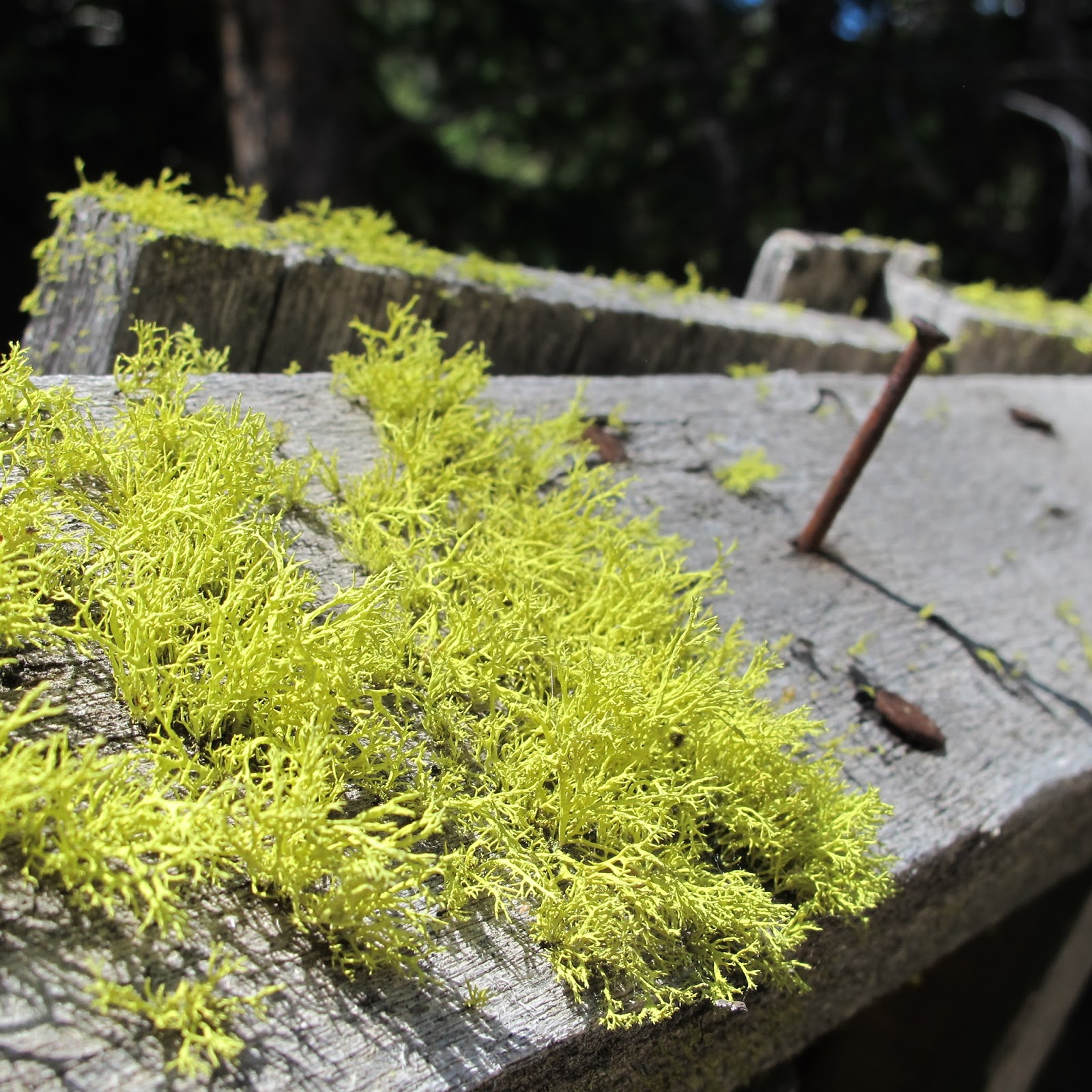
OK, at least one art photo!!!  Saw patterns, grain, nail shadow and green


Indeed the ghosts still live here, and in all these towns, they are visible to my minds eye, a glimpse into the past still living today.  And they will only disappear when the last vestiges of these towns are finally reclaimed by the earth from whence they came, like so many towns that have been absorbed since time began.

Thanks for the memories, ghosts!


The reclamation tool: lichens!

Tuesday, July 5, 2016

The Secret of Hills - Part 2: Finding the Way Up

People often ask me what I do to entertain myself during long days in the saddle. The answer is really quite simple - the trip is its own form of entertainment.  Mostly, it is about looking at a new scene, the detail at 12 miles per hour, or even 4 to 6 miles per hour climbing.  There is so much time to fill, my mind is never silent.

And nothing occupies the mind more than climbing hills.

I have already written about Logan Pass in Glacier, the king of climbs on this trip in terms of magnitude, all brainwaves taken together.  Or the "minor", unmarked pass of Old Woman's Grave road, minor as in "routine", but had the power to mystify - on this already written.


When will this end?   
Will the summit approach be abrupt or only a gentle saddle?
Will there be a view?  A sign? A welcoming committee?
That light of horizon through the trees, silhouetting the ridge above, is getting lower, dropping as I rise
Oh those thighs are starting to burn, ease up a bit, can I switchback across the lane?
Ten up!  Stand,  Oh there, a bit better for a fleeting moment.

But of the other climbs?  There is much challenge surveying the landscapes ahead and to "read" them, predicting where the pass might cross. Or, as one climbs, to read the geometry of pitch, traverse, and elevation, sensing the optimal way to power through this rising terrain. There were some remarkable climbs, and many unremarkable ones born of necessity, merely to get to ones destination, not the anticipated "prize". One truth is herein spoken - that climb at the end of a long day is the hardest physically and mentally.  The long climb first thing in the morning is fresh and energizing (though many would disagree on that point).


What's that new squeak?
How can flowers grow in such tiny crevasses of rock?
Cool striations in that rock!
What's with these flies circling like satellites?
Scooch little yellow butterfly, flying so seemingly uncontrollably.
Those shifting clouds, occasionally masking the intense sun

Consider the minor passes, unmarked and otherwise unremarkable between Helena and Three Rivers. Or between Norris and Ennis over the Bozeman Trail: wide open range lands, wide views of the valley behind and mountain ranges astride, extreme sunshine and often fickle winds.  Or the unmarked Stemple Pass (6,376'), a gravel climb, very steep, less than fully "engineered".


Granny*, you still there?  Ah yes - haven't sung your praises yet. You're in reserve in case I need you!
Wish I knew Mom's mom - I remember Oma.
What would Dad think of this trip?
 God it's hot
Wish there was a tailwind - would it make a difference?
Looking at the shadow of me grinding, creeping slowly past the gravel.

Or the morning climb over an unmarked pass between Ennis and the historic old town of Virginia City (first capital of Montana), itself situated on the west facing slope of the Greenhorn Range - a steady rise out of the Madison River valley through dry scrub, the road up ahead fully visible, switching back and forth to an unseen pass, the passage through which can only be speculated upon, with every mile higher the coniferous forest cover starting to appear, in full form at the physical pass.


There goes the coyote - slipped slyly right under that fence.
What was that bird?  Oh, an oriole!  Becky would know!
How did this underwear get to the side of the road?
Does anyone in a car see these delicate flowers?
There goes the deer - be careful

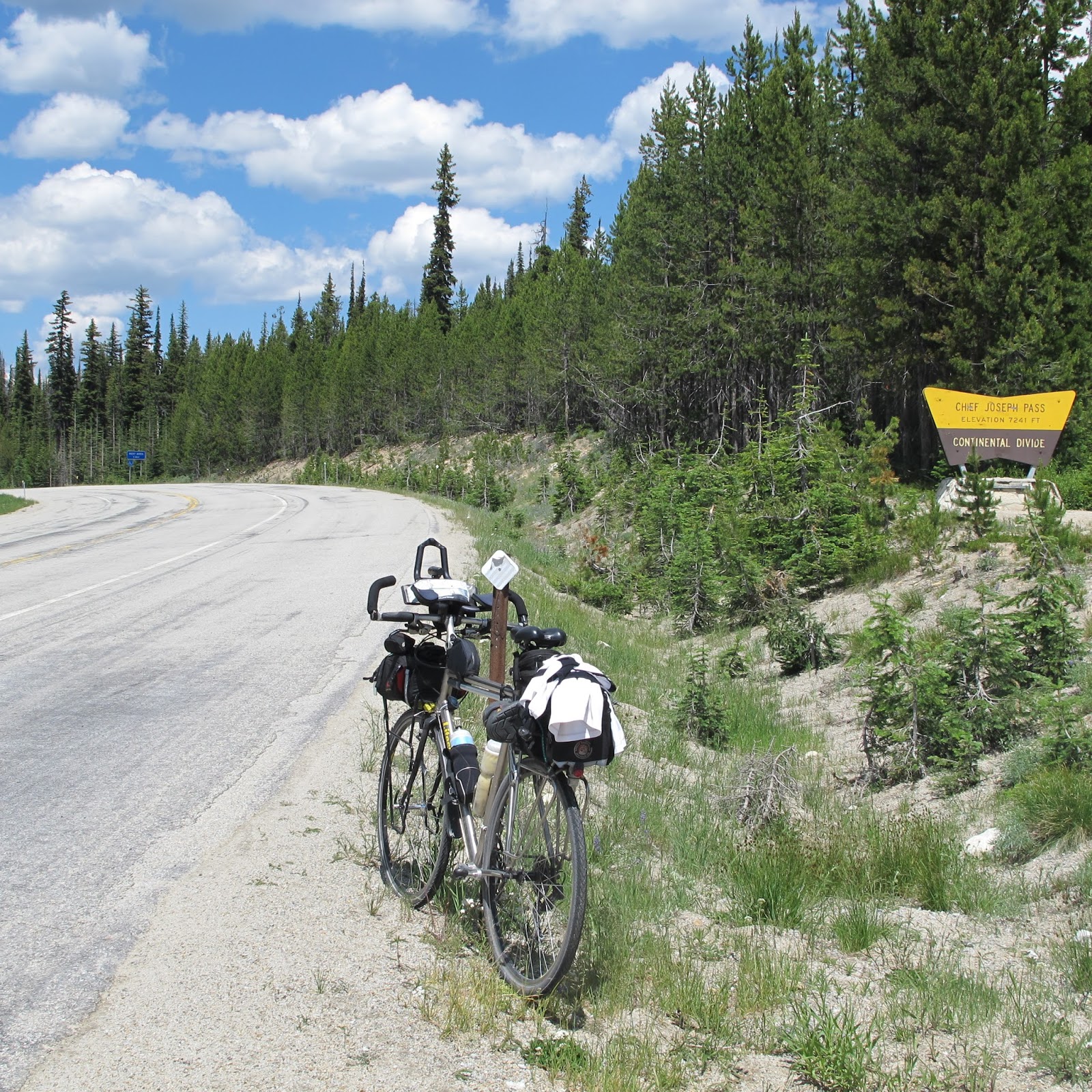
From Dillon, the climb over Badger Pass (6780'), though anticipated on the map, was a steady, beautiful climb through mostly wooded forest over a broad pass, revealing the Grasshopper Valley ahead, a dry, scrubby expanse leading to Bannack (the first territorial capital).  This followed the next day by a steep climb out of the Grasshopper Valley along the PioneerScenic Byway, a wondrous, mountain environment with a fresh morning forest smell, wide open alpine meadows with snow capped mountains of several ranges all around.  The Chief Joseph Pass (7,264') climb from the open Big Hole valley out of Wisdom followed this pattern of an evolving landscape, rising gently at first, steeply toward the end.


I can hear you, but can't see you Mr. Screech Owl
Why is there so much cowshit on the road?**
Sound of rushing water - climbing, rising and fading away
That ditch has water flowing - what collects there? Oh, there is not much shoulder - have to hold the line.
Car coming - I spy you in my tiny mirror.  staaaaay wide - righto!
A bit of a blind inside curve - need to pedal harder to get around to be visible. Oh, but . . .
Have I really climbed this high already?


And perhaps the most daunting climb was the final major climb, the Skalkaho Pass (7,260'), following the Skalkaho River to its source - a waterfall - high up a winding steeply sided canyon road, itself largely unpaved and single lane with no guardrails, stunning for the evolving views, and its ability to hug the steep canyonsides.


The light - the light is perfect, casting a bright spot on the forest floor
Look at those wildflowers.
Awww, look at that fawn staring me down.
Should I stop to get a picture?
Whoa, steep ravine off the side - watch your line, no railing
Doppler effect of a small spring cascading down the mountain side.
Wind in the pines, whisper as soft as the bed of needles
Creaky trees - catch that fragrance!

Oh, the reward is now given!  How quickly will we fall back down the hill?  The next valley opens up before me. Feel that speed rising with no effort, the wind washing my face faster and faster, my legs ceasing to pedal, just coasting to enjoy.


Oh, look at that view, had I climbed that high?
Nicccceeeeee!  Grip tighter.  Glance at speedometer, approaching 40
Hold it steady - cars coming down behind.
I do trust my bike at this speed, don't I?  It is rolling nicely . . .
Miles are clicking by -  long descent. Crouch for a few miles per hour more! Stay off the aerobars!
Wow, what a hairpin, lean in - see that road laying out in front of me.
Glide and ride all the way down, slowing now as the road flattens out. Have I shifted gears?

Only to do it again . . .


*Granny refers to the lowest gear available to ease climbing, after which there are none lower, literally and painfully obvious!
** The reason? The roads and shoulders are used to drive cattle to different ranges, witnessed several times.  The result is, well, obvious!

Wednesday, June 29, 2016

The Secrets of Hills - Part 1: Finding Charity

Call me crazy (many do) but I am a glutton for hills.  As I was pedaling up yet another pass - a relatively modest 2,200' (vertical) ascent over an unmarked Badger Pass west of Dillon this morning, I was trying to sort out and understand this passion.  And I think it is this: hills hold their secrets well.

One of the most intriguing aspects of hills is the lack of knowledge as to how they truly end, and how all the twists, turns and subtleties of slope and pitch manipulate their secrets.  After all, one typically has a lot of time to ponder them as one is grinding up on  bike.  There is only one certainty about hills that we all know: what goes up must come down.  But how will it go up and down, for that matter? And what hides among the curves awaiting the moment to surprise and delight?  A view? A perspective?  Wildlife? Even a change of weather?

While the trip is not over yet, there have of course been many hills, nay MOUNTAINS!  This is Montana after all.  But these mountains many, have valleys many, and the pathway up and down is not always clear.

Logan Pass was not a true surprise for I have ascended twice previously, but this time the surprise was in the weather - cold, rainy, snowy and showing a mood altogether different and unexpected. But I have already spun that tale.

Take Old Woman's Grave Road.  We were spinning quite easily from Helena last Sunday June 26 along the long, Missouri headwaters valley toward its true source at Three Rivers State Park, when we departed the main road.  Indeed, this Old Woman Grave Road was not well marked. A local resident walking her dog confirmed that this gravelly road was indeed the correct path, given a few twists and turns up ahead, with an emphasis on "up", and a vague description where one can actually find the old woman's grave.  This apparently a story of an early pioneer woman jilted by her runaway fiancee, eking out an existence within these hills, and ultimately being buried here.

Old Woman Grave Road - main coach road between Radersburg and Springville back in the day


Now this is intriguing, as well the condition of the road being a mix of exposed shale ridges, gullies, and packed gravel and clay.  Not an easy ride up, and even the perspective from the main road was deceptive as the hills did not seem that high.  But in this slow passage upward we were rewarded with some stunning views of the granite ridges and visually soft sagebrush uplands, requiring careful navigation of the ruts and gullies, not unlike some old pioneer wagon - as this was the main pioneer road between Radersburg and Springville.  And yes, we finally crested, having paid our respects to the old woman - Charity Dillon (deceased 1870, though the marker states 1872) - in this single spot, high up in these mostly barren hills, with an array of memorial offerings quite unexpected, that we would never have experienced on the flat road of the valley.  The story of Charity Dillon, as expected, is not assured as there are many stories, a legend perhaps, as she kept a travelers house near this location. (Consider this source for more information on her history, whatever you can or want to believe).

Grave of Charity Dillon, aka Charity Allen, and perhaps not even "Charity"

And therein lies just one intrigue of one set of hills, when upon descent, absent the labors of the uphill grind, we can take in the artistic lines and play of light on the landscape, another fleeting capture, perhaps?

Descending - taking in the play of light on the velvet sage.


Saturday, June 25, 2016

Signs

One cannot help but notice road signs of any kind when rolling on your bike day in and day out.   Certainly, most are standard, even necessary, but many, those that are of a commercial nature, are frequently the most interesting . . . and even welcoming:

Swan Valley Center - Condon: with all its signs of life!

None could have been more welcoming than this sign last Wednesday evening: "showers / camping". I pushed off from West Glacier on a beautiful morning, following the path previously taken in 2014 among backroads, luckily still the route memorized, arriving in Columbia Falls, then heading south toward and through the very long Swan Valley.  Nestled between two long mountain ranges, the valley contains the Swan River, the valley gradually rising along its length as the water flowed north.  There is very little sign of life in this valley other than a ranch or homestead here and there.  It was a long day, and I had planned to camp at a place I had seen on the internet, only to find it no longer existed. It was getting late, and by this time I was pushing 90 miles and getting a bit gassed.  I decided I needed to prepare to wild camp, even stopping at a closed ranger station to grab some water for that possibility, and scope out upcoming Forest Service roads I could ride to get to the river and camp.  As I headed out southward, anticipating this wild camp in what was broadly advertised at the ranger station as "Bear Country - both Grizzly and Black" (another sign?), I came upon this sign for the Swan Valley Center, and this establishment, the only one of its kind in Condon, Montana at least since the much revered grocery store burned down recently.

Naturally, this was a "sign" - no wild camp necessary!  I stopped.  Ten bucks for a tent site, and four bucks for a shower, and of course, access to this true general store with all its victuals.  Leelani, the proprietor, sold me a few tomatoes and an avocado for my dinner, and tempted me with a huckleberry milkshake, which I gratefully indulged (a protein recharge, after all).  After setting up camp, wolfing my dinner, and taking a badly needed hot shower, she made me that huckleberry milkshake, provided along with her story of moving here form California, gladly trading desert and drought for woods and winter, and now at home.

Barry, an itinerant resident here, with his 60's vintage International Harvester step van and trailer, lives a retired life, having moved around working odd jobs, and tending to the deer here.  He went on about how many deer get killed each year by cars going too fast (I can agree with that statement - 70 miles an hour on two lane roads), and how he saved a fawn, now pregnant, who is a local resident herself, and quite startled me while I was eating dinner, sneaking up on me.

Barry and his pregnant charge

And speaking of speed and signs, there are many signs along these Montana roads that are disquieting in their message, nary a word upon them.  Montana appears to mark where deadly accidents have occurred along roadsides with small white metal crosses atop a red pole.  At first, I considered the normal reaction about these wayside memorials - how sad - even more so when family or friends have adorned these with wreaths or flowers, most often weather beaten.  But most are these very simple markers.  I have seen hundreds of these so far along these roads, visible ghosts casting a pall along the roadway of its dangers.  Clearly, that is the intent, to remind motorists.  And perhaps there may be as many on other roads if all the accidents were marked, but instead are ghost-like invisible, and not the reminder it truly is.  And this, the most decorated multi-death site, fairly recent as the rubber marks on the road were still quite visible, adorned with a hockey glove and stick.

A sad roadside memorial - one of too many
 

But signs continue to entice and entertain.  Riding from the wooded Swan Valley Thursday into the wide open plains, amid rising heat and wearniess, I set little goals along the way, one of which was to stop in Ovando for a break.  In this very tiny hamlet, having ventured off the main road into "town", there was this small establishment: the Stray Bullet:

The Stray Bullet Cafe - Ovando

This could not be passed up - I was the bullet straying from my trajectory and landing here.  A log structure originally built in the late 1800's as the general store, now operates as a small cafe.  I enjoyed the soup and sandwich, but most enjoyed the enormous piece of homemade peach pie with ice cream.  Along with this, sitting at the counter, I was able to learn more of the story.  The cook is also the schoolteacher, and has been for many years.  The school in town has seven students between pre-kindergarten and 8th grade.  I was astounded, for in many places there would be no way to support a school with so few students.  When she started, there were fifty or so.  But the community, primarily built around fifth generation ranching families, have personally funded an endowment to pay the teacher.  This is the story now repeated threefold about Montana communities coming together - whether from Leelani, Barry or now my server/cook.

And what of the stray bullet?  This town was once bustling, with a bank, a few bars, the usual.  One night a fight broke out and the stray bullet went through the store window and embedded in the log walls, where it still sits today.

I finished the day in Lincoln, after having my first flat tire (always on the rear tire it seems) going uphill but 10 miles from town.  Was passed by another biker, who offered help, but continued on his way, indicated his stop also in Lincoln, at the Sportsman Motel.  Once repaired and rolling again, I did the same, and Dave and I met for dinner at the only Mexican place in town, sharing our stories with good local ale and pretty solid Mexican food.

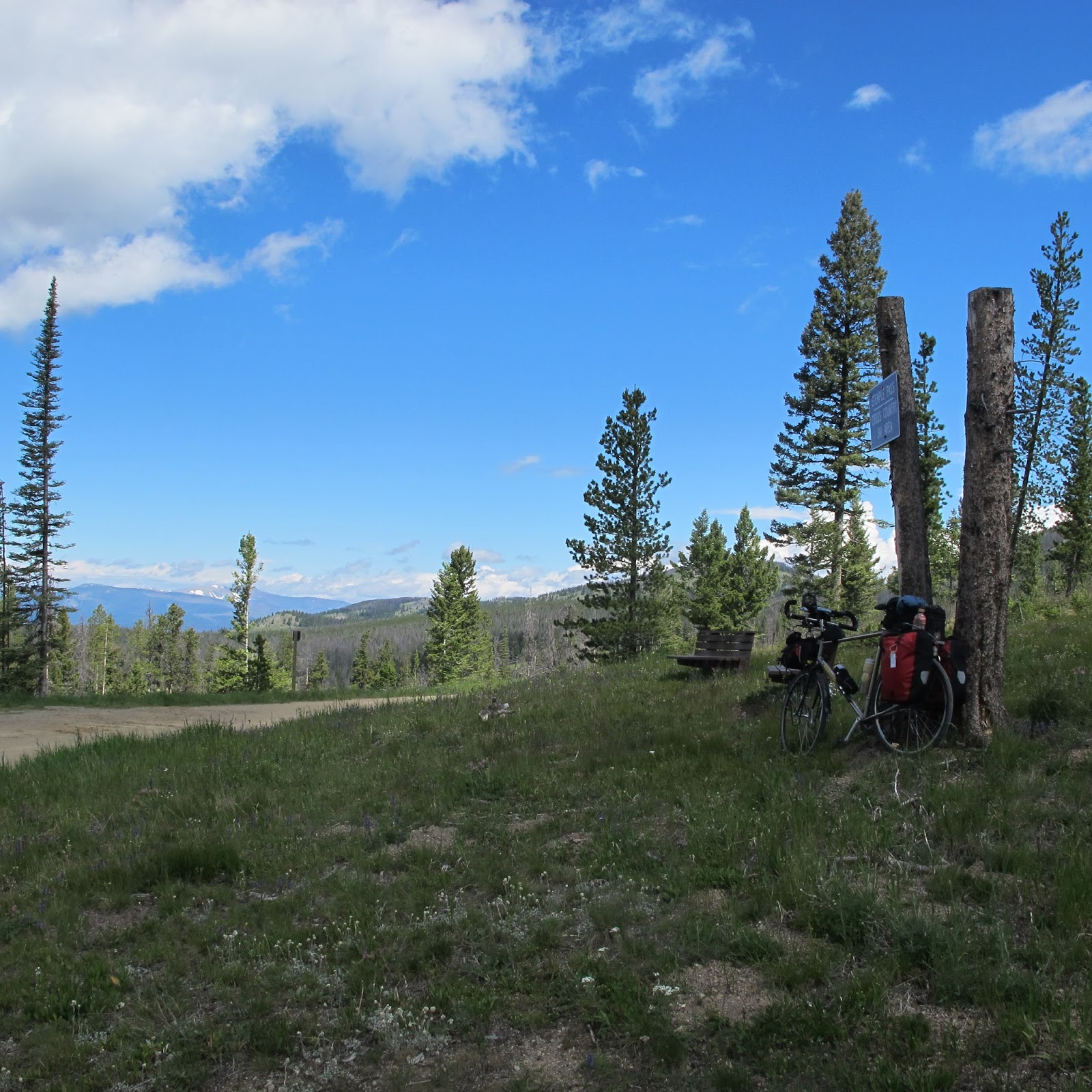
Friday morning I arose early, knowing I had a choice in two possible passes over the continental divide to cross on my way to Helena, and in poetic fashion, chose the one less traveled by - Semple Pass - a gravel road for its duration and (likely) absence of much traffic.  Fifteen miles up to the pass, the last five of which were very steep, in which I muttered endlessly with "Granny" - the lowest possible gear ratio known as the Granny gear.  Marked by one sign "Semple Pass Cross Country Ski Area" I was pleased not to be experiencing snow again, though it was quite cool.

Semple Pass - 6,376'

But one last sign -for now.  I descended from Semple Pass, back down into the wide open plains, where I could see the emerging storm clouds.  These prairies are amazing for their vast openess and big skies.  Thankfully for me, the storms were pushing a very strong tailwind that enabled me to click through the miles gleefully fast, but pausing when I came across this:

Canyon Creek General Store and Post Office, and . . .
The Canyon Creek General Store and Post Office.  There is almost nothing in Canyon Creek - again a ranching community.  As it was about 12:30, I chatted with the proprietor awhile, sitting at an antique table in this very cluttered store, a mix of provisions and antiques - all for sale - watching a regular stream of locals come in and shuffle back to the mailboxes to gather their mail, exchanging a word or two in the process.  And so, in another moment of profound weakness, I was sold a dish of huckleberry ice cream (with syrup), and the story of this place, a general store since the early 1900's. I bought a postcard and mailed it home, and packed in a jar of huckleberry syrup.  That was lunch.

I spun easily through the last 20 or so miles into Helena, glad for a break off the saddle while I await arrival of my biking "bro's" for the rest of the journey.

Tuesday, June 21, 2016

Going To The Sun . . . Sort of!

Left late last Saturday on vacation - the annual bicycle trip - this time, again, to Glacier Park and western Montana.  I love Glacier Park, and most especially the magnificent Going To The Sun highway, this my third time over the top, trying to get closer to the sun.

Except . . . well, we'll get into that.

Boarded Amtrak for East Glacier, and had a fairly uneventful ride, only an hour late pulling in which is pretty good for this route with its tardy history dodging oil trains in NoDak.  But I love seeing the varied landscapes, this time in beautiful weather and a comfortable seat that afforded me only modest sleep over the 21 hour trip.

Stayed in the East Glacier Lodge - conceived by Louis Hill (son of Great Northern Railroad founder James J Hill) around 100 years ago, one of three such railroad lodges in Glacier.  A very smart move on the part of these railroad men - while magnificent in its use of soaring timbered spaces, the rooms are less than "modern" and really hark back to a simpler time.  But the prices are definitely modern.
East Glacier Lodge
Climbing SR 49 north out of East Glacier
 I missed the opportunity to visit Many Glacier two years ago at the end of our Icefields Parkway tour, so this time I made a point of heading up there yesterday, skirting the east side of Glacier Park with some fairly good and lengthy climbs, definitely tested my absence of solid training.   But the day was magnificent - cool, clear and only the fairest of breezes - perfect riding weather, and some amazing scenery.  Many Glacier is as deep into the base of these mountains as you can get on a vehicle - you can reach out and touch then, or so it seems.  And the alpine lakes are crystalline with a blue green mineral cast.

Approaching Many Glacier along Lake Sherburne
After three good climbs and 54 miles, arrived early and set up camp at Many Glacier in the hiker/biker spot, and quickly befriended Chris, a recent PhD recipient in biomedical engineering from Pittsburgh, seven months into a one year trip around the country, along with two through hikers on the Continental Divide Trail - both living to hike on long journeys, escaping (for now) the reality of work life.  The four of us enjoyed a lengthy evening conversation - I find it amusing as an elder (I could be their father) as to what these folks talk about - quite fun to learn actually.  Took a four mile hike around the lake, and stopped in for a beer and a pretty good sandwich for dinner in the Many Glacier Lodge and its soaring "swiss style" dining room - yes, another Hill legacy being extensively restored. This was perhaps chosen in favor of camp food as I erroneously forgot to stow my camp stove in my trip gear!

This morning I awoke to a familiar patter of light rain on the tent - it is a somewhat dreaded sound as it tends to add a level of morning stress (how much rain? Scramble to take down camp?  Breakfast how?).  It was light and intermittent, but dark clouds forebode more to come from the west. Broke camp around 8 and headed down to the Babb valley, and on to St. Mary, and a blistering headwind to start the Going To The Sun highway ascent, with dark clouds draping the crevices of distant peaks.
Departing Many Glacier - chased by rain and rainbows

I'd like to consider the notion of having taken a wrong turn, for this was not going to the sun, but going into the head-windy rain, that became heavy, cold, and loaded with sleet and snow after my 2.5 hour ascent (18 miles, about 12 steeply up).  And there was still much snow along the roadsides in the upper reaches. This is a bad time to realize that I forgot to pack my rain pants, and so I ascended in my shorts and sandals with wool socks - it was 44 degrees at the top, and just ugly cold, with an unheated Visitor Center, and no hot beverages, or even cold ones (no water).  But they did have hand warmer pouches and fleece gloves, both overpriced, but at this point, a saving grace for my upcoming rapid descent through this crap.  I put all 3 layers I had under my raincoat, and still shivered, almost uncontrollably - I do not recall ever being so cold.  The descent would be difficult in the rain and fog, having to grip the slippery brakes harder with potentially cold hands.  But the gloves and warming pouches saved me - not so much my feet which froze - and it was everything I could do to prevent full body shivers causing me to uncontrollably alter my trajectory.  But the rapid descent did get me quickly into slightly warmer territory.

Approaching shrouded and wet Logan Pass.  There were so many waterfalls!

But in spite of  the conditions, the ride was epic, not only testing my endurance, but also giving me a different view of Glacier in these conditions - still a monumental, awe inspiring sight

A moment later - shrouded - a true fleeting capture
The Going To The Sun road - west side descent
The sun finally came out, enabling me to shed my layers to warm up as I approached West Glacier a few miles away, 72 on the day, and a nice, hot shower and a good meal at the Glacier Highlands Motel revived my spirits, body temperature, and proclivity to actually write about it.

First day of summer?  Hrumphh!  I guess I'll just eat my sweet reward now: homemade huckleberry peach pie.  At least that is summery!

Monday, June 20, 2016

There Is Joy In Mudville . . .

With apologies to Ernest Thayer and his poem of the downtrodden baseball team of the late 1800's, I recently returned from the rainy season in Honduras, and there was much joy in this visit.

A more or less routine visit to check on the progress of my projects there, I had not yet seen the progress of the chapel that I had designed for the Surgery Center.  Only on paper has my vision yet appeared, and much dialogue about how to construct a warped roof plane of metal panels was really my only clue to its progress.  Some context is in order.

Designed to seat about 60+ souls, the chapel's nave is trapezoidal in shape, wide by the entrance, narrow to the apse, with a roof ridge that rises from its lower point above the entrance, to its culminating high point above the apse.  The effect, when entering,  of the false perspective makes the apse appear farther away, and from the altar, the congregation appears enticingly close. So to keep a horizontal and parallel edge along the sides of this trapezoid, geometrically the roof plan must warp.  But I believe the workers perhaps thought my mind was warped (which indeed, it may well be), for why would anyone deliberately design such a roof, in a place where all roofs have a single slope?  Simply, because the design warrants it.


 And the apse, flanked by two niches, is a perfect quarter sphere, designed to be above the altar and enclose the tabernacle, to draw attention visually, but also project acoustically.  The whole is surmounted by this relatively simple roof that appears to float above the stone mass of the walls by virtue of its open light and airy-ness.  The effect, if I say so myself, is interesting . . . on paper.
But to see it take shape in the field  was a moment I will cherish - I was awestruck and giddy.  Made of stone, hand hewn and cut of steel chisels and hammers out of the very slope upon which it is built, the walls and most especially the quarter spherical apse, is simply magnificent.  The niches, designed to hold statuary, is also a gently curved wall that bends the back light around the statues.  But unlike my plan, which had a simple entrance, the workers deviated in a major way.   They constructed an arch, again of hand cut stone, precisely fit, with no mortar, locked in by a massive, precise keystone, the heavy stone walls rising above it to the roof, locking the arch as has been done for thousands of years.  

I did not design so "complicated" an entrance, preferring to keep it simple, and presumably more cost effective.  No, this is of the workers, and represents their obvious pride in their work.  According to Rigo, my local engineer on this and all the projects, this was a labor of love, a calling to work on a church is a high order indeed.  The craftsmanship reflects this.  Even the lone stone cutter appears content in his makeshift. tarp covered work station, chipping away, unlocking ancient layers to just the right age - here and now.

Though still awaiting its wood ceiling and all the glass, the first mass was held there last weekend, a blessing upon this chapel, and certainly to the workers toil and craft to create such a beautiful space.  And emotionally, this singular project holds special personal affinity for me - a special, unique space that will last a long time, and almost everything I had imagined, and more.


There is profound joy in Mudville . . . or shall we say Rockville?