Saturday, January 14, 2017

Making a Difference

It is not common for students to fully comprehend the magnitude of their work when they arrive in San Ramon - to them it may be a bit of work on some project with a lot of fun squeezed in around it.  In truth, it is a lot of work with some fun squeezed around it.  And today, again, for the fourth year, I felt our teams made a difference, and I am proud of their accomplishments.

In both cases, presenting our project proposals to the Centro Communidad Chistiana (Community Center) and the Hogar des Ancianos (Senior Center), we presented options that had not been considered by our "clients" - with thoughtful study to support them, giving them a fresh perspective on what is possible for their facilities.  And the gratitude expressed by the full Board of Directors of the Hogar was heartfelt, genuine appreciation for our proposal, spoken of course in Spanish with rapid fire excitement.  
The Hogar Board and our team


A passionate Nolan Rinta 


Presenting to the Centro Communidad
Our superhero: Fernanda!

A special "shout's out" to our Facility Management student, Nolan Rinta, who made the presentation solely and completely in Spanish; to Michael Vearderko for being a strong Project Management leader for both teams, providing stewardship and guidance for both project teams; and most especially to Fernanda Rojas Ramirez, a local university student who provided excellent language translation, interpretation, and friendship, to the entire team of both Construction/ Facility Management students, and to the Integrated Behavioral Health students, and who was quickly adopted by all of us into our activities.  This was the first year of an integrated tour with students from three different programs represented.  It started out neatly divided along program lines, and in this great end, was an integrated collection of interested students.

A bad picture of a great walking club on top of the world:
(L to R) me, Emily, Caty, Liz and Jason
And of course, I must recognize my compatriot walkers in the adhoc Hilger Walking Club, dedicated to an early morning, sleepy departure at 6:00 AM daily, for a hike lasting 3 to 4.5 miles each morning, with lots of very steep hills. We bonded with every step, and with every step absorbed the early morning culture of San Ramon and the surrounding countryside, which is actually quite active at this hour.  I am indebted to Caitlin Kerber, Emily Hedberg, Liz Skweres and Jason Sportel for their companionship and diminishing complaints as the days, and hills, wore on.  We will finish with well over 40 miles for the trip.

Finally, I must acknowledge the enduring companionship of my colleague on this trip, Ann Becher-Ingwalsen, Professor to the IBH students, but the "Mother" to my "Dad" as we watched and wondered about our "kids" - ever vigilant we were when we really said we didn't need to be so doting!


Ann - launched and gliding through this tour!
And of course, all's well that ends well, especially when it is a fully stress relieving rainforest canopy zipline tour, and a "celebrando" at Xenia's house.

Anticipation of the Tarzan swing


Anticipation of  the glide ahaed.


Superman would be proud, gliding over the gorge.

The fourth, very successful  Pura Vida tour, now over.  Goal accomplished. I love this job, but beam me back!    

The 2017 Pura Vida Tour

Thursday, January 12, 2017

Trapiche

I was expecting only to catch up with my good friend Alejo, the coffee farmer whom I befriended 4 years ago on my first visit to Costa Rica with my students, and Rafa, one of our project hosts at the time, his son Reime (studying architecture in San Jose), and Dustin, leaving the students behind in their work.  I have managed to touch base with Alejo every year since, and it is always a pleasure.  In spite of their suggestions to the contrary, I did not recall ever having "agua dulce", and so it was that we agreed to meet at the "Cafeteria Flory", a small soda (local restaurant) for this specialty local drink, located north of Piedades Norte, high up in the coffee/rainforest/sugar cane boundary region, in a heavy, damp cloud based mist, delightfully in the middle of nowhere.

Our visit to Cafe Flory: (l to r) me, Alejo, Rafa and Dustin
What I was first treated to was a small glass of an orange liquid, described to me as containing pineapple and orange juice, and a bit of "contribando" - moonshine!   What a terrific wake-me-up! This was followed by two cups of agua dulce - basically hot sweetwater drink made from sugar cane, one cup "con leche" (with milk) and one without, for me to decide which I preferred (con leche!).  On this cool misty morning, this was an excellent warming treat, and I have no recollection of ever having it, but the "contribando" may have, at this point, clouded my memory!  This accompanied a lively discussion about architecture, construction, and politics,  enabling me an opportunity to work on my Spanish.

Juice laced with "contribando"

Agua dulce, with tostadas and "picadillo", a potato based
lump of goodness .  The packages of jerky - "carne" is a long
running gift to Alejo, who loves it and hoards it!
But what I was not expecting was the "trapiche" - a sugar processing facility that seemed at home in another century. Located next to the soda, I learned that the family of  Brothers Aria (Trapiche Hermanos Aria) process sugar during the season every Wednesday, in time for distribution to the local farmer's markets held on Friday and Saturdays.  We were able to wander this tightly packed ramshackle facility, shrouded in steamy fog, to see the entirety of this operation from raw sugar cane to finished "sobado" logs and "tamuga" blocks of pure sugar.

Trapiche Hermanos Arias

The sugar processing area: cauldrons on left, mold table on right
and sobado mixing at right rear.
The process is quite simple, and certainly time tested.  The sugar cane comes in on a cart, and is fed by one man through a grinder (this one motorized, in the old days, by oxen).  The raw liquid, drinkable and not as sweet as one might expect, then flows to a heated steel cauldron.  The crushed canes, devoid of their liquid goodness, is then stacked to dry. This first cauldron, the largest of three, is boiling the liquid, and is skimmed of its foamy surface.  This foam, called "espuma" is also consumable, and is purported by those around me to be even better than certain virility enhancing compounds in popular use!  It has the consistency of a fluffy mousse-like pudding, and is quite tasty all on its own, but is not sold.

 dulce espuma - the sweet cream of manhood! 

Grinding the cane, note the small
white pipe flowing drinkable cane liquid.
The fire pit, fed with dried cane stalks


The liquid in the first cauldron is ladled into the second, slightly smaller cauldron, similarly skimmed, and is then ladled into the third, smallest cauldron for a final boil, the liquid becoming more concentrated and syrupy in each cauldron.  All three cauldrons are heated from below by an upwardly sloping flue, from a fire pit below the first cauldron, stoked by a man feeding dry sugar cane stalks into the fire with a well worn wooden stick.

The molds . . .
turned out to cool . . .
before having their bath.
 From this third cauldron, concentrating all the sweetness of the cane syrup, the fluid is ladled onto a wooden chute to fill a long wooden trough, constantly paddled to prevent solidifying as the liquid is ladled into wooden molds, which then set, and are eventually turned over, still warm, onto a table to finish cooling before being packaged.  On another table, this hot liquid is used to stir in other ingredients, such as nuts, to form the sobado logs.

The final cauldron, in a thick boil.
Note the large ladle above.
Working the warm sugar into sobado 
What an unexpected surprise, this adventure!  And to be so close to bear witness to this operation, to see the family working together so methodically, was a treat.  In the course of conversation, there was some expressed regret though.  The market for this raw sugar has been steadily shrinking over the years, to the chagrin of the older brothers, who casually asked one of the youngsters (perhaps 10 years old or so) whether he preferred this sugar, or Coca Cola.  His response was predictable and a sad sign of the times.  Coca Cola, to their credit at least in Central America, uses cane sugar, but indeed, Coca Cola has not been around nearly so long as this process, which I suspect is very old.  I only mentioned that perhaps, as all things seem to work in cycles over time, the rediscovery of this pure, raw form of sugar as possessing some new health benefit, will again increase demand.  Virility perhaps?

I can only say how sweet it was!


Sunday, January 8, 2017

Creatures


The groaning sound of howler monkeys surround me in this predawn moment, as I am overlooking a calm Pacific from the terrace of the El Faro Beach Hotel.

My morning blogging perch: the Pacific, two Toucans and am iguana!
For  the fourth year, I, along with my colleague Ann Becher-Ingwalsen, am privileged to be taking 18 students on a Study Abroad opportunity to Costa Rica in service to several organizations that could benefit from their work.

But this morning I am reflecting on the diversity of species witnessed on this trip, starting with an early morning wander through the Manuel San Antonio Park, a visit to the rocky beaches, and ending with a night tour of a local private natural reserve (as all the national parks in Costa Rica shut their gates at 4:00).  It was a day full of creature stimulation.

The highlights for me were observing a group of howler and capuchin monkeys on the trail to Puerto Escondido, and seeing a small snake, the blunthead tree snake, draped upon some branches, assuming itself the still posture of a branch, and thus barely noticeable.  They are no fatter than a piece of cord, and can get over 30" long, and will stretch its skin to consume a frog.  We wandered around this private preserve, flashlights from our small group flitting across the dense forest that would certainly evoke a horror film, learning as we went on how to spot these mostly tiny creatures.  Absent a guide from whom we could observe the technique, a solo wander would have missed this abundance of life, with only the frightful sense of what creatures lurked unseen in the darkness.  It was a wonderfully eye opening experience.  But also the diversity of birds, flora and fauna captured in my mind, and lens, is what inspires me to wander and absorb.

And perhaps the tale is best told through the lens of my camera, challenged as I was to capture these images adequately and hopefully, mostly in focus.  Though out of focus some may be, the memories are quite sharp.

A howler taking breakfast - I could watch, and listen to them,
for hours
Leaf litter in a stream - turtle habitat
Fugus


A rock crab evading detection

Mama and child Capuchin monkeys

This spider, a moment before on its web,
evading detection by flattening itself against the trunk

Definitely an intimidating creature, a type of scorpion spider

A common tree frog, of which we saw 8 different species

The blunthead snake,
holding this position quite long and still - branchlike!

Another treefrog - am I lucky or what?

A very large type of bullfrog

An anole lizard

Leaf cutter ants moving so rapidly it was hard to catch them,
except on my foot when I crossed their path.

A type of grasshopper blending oh-so-well into its surroundings.


I count six monkeys in this photo!

And of course these "creatures of the morning walking habit",
Peter's Walking Club 2017 with (L to R) Emily, Liz and Caty,
A dedicated crew these three - nearly every morning!

Sunday, December 18, 2016

Tocayo

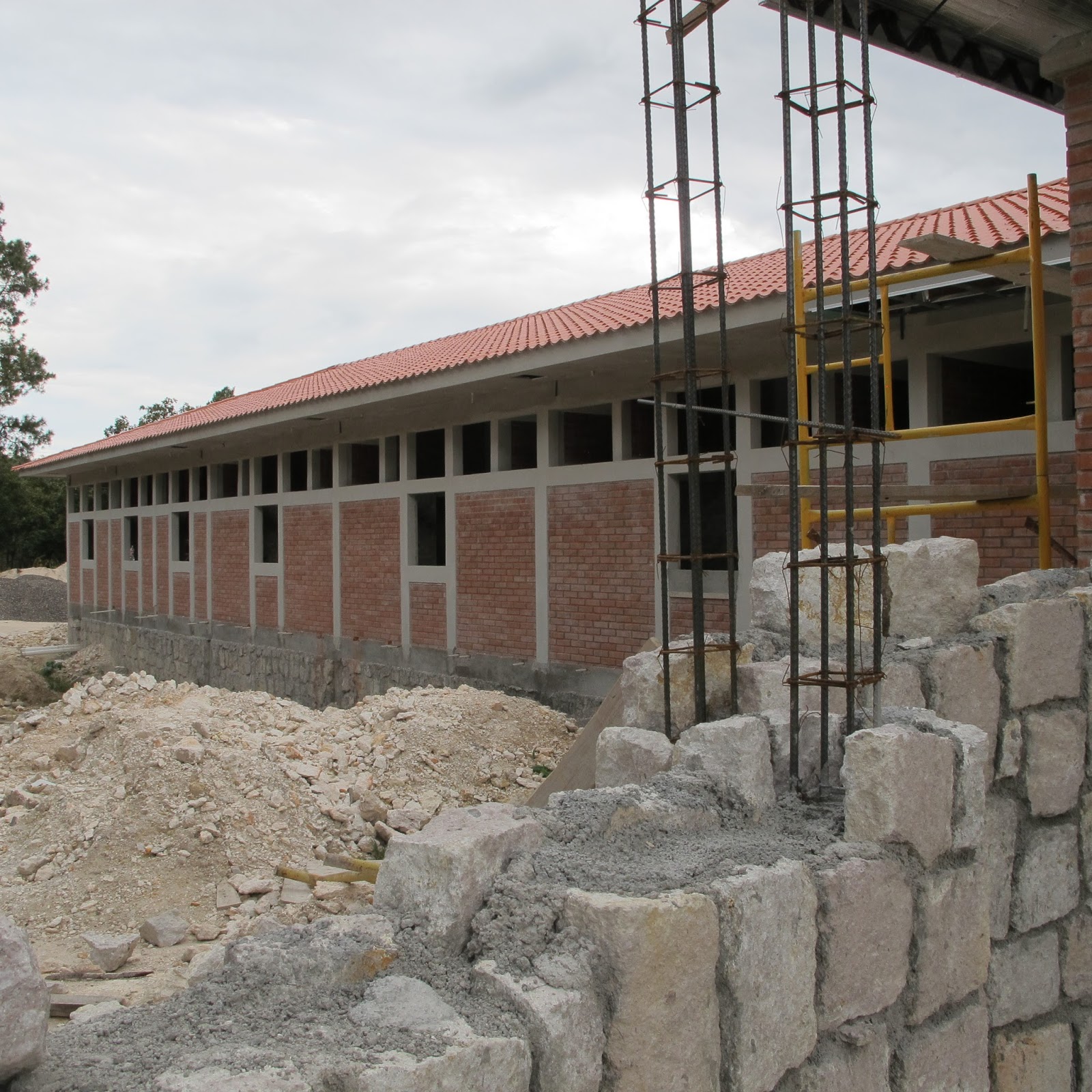
Last weekend I spent a long one visiting Nuestro Pequenos Hermanos (NPH) - my project currently underway in Honduras - to take stock of progress.  To remind, we are constructing a dormitory and large conference facility to host medical bridgades and to host seminars for local medical teams.  And I suppose, there will be purposes served in this large meeting room for the children and staff of the orphanage.  (See my earlier post: Brick By Brick)

Oh yes, I did take detailed stock of the progress, assessing conditions, reviewing details, clarifying the details of design, and reporting on the general progress representing as good a quality of construction as Honduras can produce under these circumstances.  I am pleased and excited by the prospect of completion, quite likely to happen by the first of March.  Proverbial light at the end of this long tunnel.
View of the front of the Conference Center

The center courtyard emerges, dormitory surrounding


Half of the main meeting room, view toward the stage, with cupola above

Rubble walls under construction, with dormitory wing beyond

But what really delighted me last weekend is being able to spend so much time with Axel, my god child whom I sponsor - my tocayo - two people who share the same name.  He turned 17 in August, recently graduated from high school, and must now complete his year of service to NPH before attending college, with the ambition to become a doctor.  So with the weekend largely free, Axel spent in tow of my inspections, tutoring me on my nascent yet emerging Spanish, and visiting with other "pequenos hermanos".  

Two Axel's - "nosotros estamos tocayo" - on the mountaintop

Sunset from the mountaintop
We hiked to the mountaintop to take in the sunset.   I brought him some watercolor pencils for Christmas that, around the table, were tested on an unusual still life of wine and hot sauce.  I brought a gift to Zuany from her "madrino", my co-worker Megan, and spent an hour goofing around with her Casa Suyapa roommates, with my resemblance to Santa Claus not missed on them.  And though Axel absolutely demolished me in a game of chess, a  tense game with Isaac in the clinic, born with aids, ended barely in my favor.  
 
Zuany with her new "trolls"

Clowning around

A game of chess with Isaac in the clinic

Axel creating his still life - he is quite an artist


A brilliant sunset from Casa Romano

And I suppose I just wore the poor lad out!
 Though the weather was mostly wet, a bit unusual for this time of year, it contributed nothing toward dampening my enthusiasm and delight with this visit.  Bricks and mortar are important as shelter, but these relationships are so important to the pequenos in any weather, hopefully reinforcing their foundations.  I am so honored to be a part of both these projects!
 

Wednesday, November 30, 2016

Still a Civil War?

Yesterday was a fairly dramatic day  in the mundane life of a lowly State Capitol Preservation Commission "public member", as I am.  Having  also been assigned to the Art in the Capitol Subcommittee, I did gain quite a bit of knowledge and thoughtfulness on the appropriateness of art in the capitol, especially "controversial" art.  Yesterday, the issue of keeping the six paintings depicting Minnesota's famous Civil War regiments on display in the splendidly rich Governor's Reception Room and Anteroom came to a head, with the Governor himself storming out of the meeting claiming partisan politics at play.  I was in the sausage factory!  But I have had no political ax to grind in this Commission appointment, but only my perceptions of what is the right thing to do.    

And so I delivered my one opinion, as follows, amid all the political noise:

My Fellow Commissioners,                                                   November 29, 2016

I have greatly appreciated the opportunity to serve on this commission, but especially the Art Subcommittee, where I have had an extraordinary personal learning experience, gaining not only an appreciation, but a deeper understanding the public appreciation for our State Capitol.  It is truly a national monument, not only to the architecture of native son Cass Gilbert, but to the builders of our very State, and the defenders of our very existence as a unified country.

History matters, and art matters.

That is why the Civil War paintings must remain in the Governor's reception room.  They were designed for this room, and this room, and the capitol itself, is a monument to these veterans.  Can you imagine the rotunda without the paintings?  The chambers?  All the paintings make this Capitol so very special.

Why do I argue so?

Some might say this is inconsistent with my support to relocate, within the Capitol, the Treaty of Traverse Des Sioux and the Father Hennepin paintings.  Initially, I was opposed to this, preferring to keep the Reception Room as it was, but I was persuaded by my colleagues that Father Hennepin was simply not accurate in its depiction.  Traverse des Sioux is no different, in my view, than a photograph by Matthew Brady would have been of the same event - it is a moment in time, and is more or less accurately represented without overt bias.  But I have come to understand how this defining event of our State's existence still inflicts pain on the Indian community, but whom I think will agree that even these tragic events should never be forgotten, but appropriately interpreted so we can learn from them.

We think nothing of looking at the Matthew Brady photos of the Civil War, as emotional as they are, vivid in their portrayal of ordinary men in extraordinary circumstances, and are moved by the horror of the battlefield, be it blue or gray.  If we put those photos in a back closet, never to see the horrors of what a civil war can wrought, how would our descendants ever truly learn?  How would the horrors of civil war ever really come to life?  Civil war is a historical fact around the globe, with most nations having experienced a defining civil war as part of their heritage, so we are not alone in suffering the pain of internal conflict, and we need  only read the current headlines to know civil war has sadly not been extinguished by humanity.  I am sincere in my opinion that these paintings, none romanticized, all depicting historically accurate events with ordinary Minnesotans doing extraordinary service, do more to reinforce how fragile our nation's very fabric was during this war.  
We were so close to shredding that fabric in the early 1860's, to having the United States as we know it today not even exist. Lincoln was perilously close to losing it all, his fight for abolishing slavery sliding precariously toward defeat.  Even the English and the French were close to entering the war - on the side of the confederation - merely to protect their cotton trade, and preserve the status quo for their own benefit.
 
The Minnesota regiments were at the forefront of protecting liberty for all, for the State, the Nation, and all of us as citizen descendants - they were "our" veterans in the same way we honor more recent veterans for their sacrifices.  We would no more "relocate" their monuments than we should for these Civil War veterans - common men making great sacrifice for our way of life, critically supported by the women and families here at home, assuring our free nation and State for all Minnesotans today.  They played a hugely critical role in the War - let's honor that in the best room in the people's house.

In my humble opinion, if it is even that, there is no room more honorable for their sacrifice and enduring legacy than the Governor's Reception Room.  But in order for the lessons to be learned by our present and future generations, these painting must be interpreted, so the lessons of this horrific conflict are never lost on our present and future visitors.  And further, these paintings are sufficiently large that to relocate  them elsewhere in the capitol would take up the important, valuable "real estate of wall space" needed to tell all the other great stories that need to be told.

Please, my fellow colleagues, keep the civil war paintings in the place of honor originally planned for them, as their monument, and let's continue to honor and learn from their sacrifices.

The Second Minnesota Regiment at Missionary Ridge (Gettysburg) Nov 24, 1863
Painted by Douglas Volk

This was received with applause by the audience, including a contingent of veterans, ironically delivered in the Veterans Services Building (temporary  quarters of the Governor during the restoration), and even a  "sign on" from several of the Senator's and representatives in  attendance.  And eventually, the vote reflected my position, now in the hands of the Minnesota State Historical  Society.  And as I approached the building before the meeting, I was struck by all the war memorials on the Capitol lawn, and thought we would never approve removing these memorials that each tell their own important story to some other location simply  in the interest of change times and thoughts.

What is perhaps most interesting, is that all the local media carried the story, (including  the Pioneer Press citing a part of this speech) not as much  about the art itself, but about the Governor walking out of the meeting!  That action probably did more to call public attention to this important issue, then all  the good work  that went into just getting  to this point!

In politics, the war is no longer civil, to be certain, and as history will inform, never has been.